Engaging Narratives: Exploring Climate Change Communication Through Subject Matter and Genre
- ianqferrer
- Feb 2, 2025
- 5 min read
Updated: Feb 15, 2025

In an era marked by rising global temperatures, extreme weather events, and ecological degradation, climate change is no longer just a scientific concern—it is a communication challenge. How do we convey the urgency of this crisis effectively? The answer lies in understanding two fundamental concepts: subject matter and genre. These elements are not just academic constructs; they are powerful tools that shape how we engage audiences, inspire action, and foster environmental stewardship.
The Importance of Grasping Subject Matter in Depth
Before crafting compelling narratives about climate change, it is crucial to thoroughly understand the subject matter—the core content being addressed. Climate change is a complex issue that intertwines scientific, political, economic, and cultural aspects. A solid grasp of these interconnected dimensions is essential to avoid superficial or misleading communication.
Studying climate science offers numerous advantages that enhance both understanding and communication in this critical field. First and foremost, a comprehensive exploration of climate science significantly enhances comprehension. Writers who delve into this subject are better equipped to interpret data accurately, grasp the nuances of greenhouse gas emissions, and identify the intricate relationships between carbon footprints, renewable energy, and policy reforms. This solid foundation of knowledge fosters the creation of well-informed content and prevents the oversimplification of complex issues.
In addition to improved comprehension, studying climate science cultivates better critical thinking skills. In an era of polarized climate discourse, a deep understanding of the subject allows writers to critically evaluate arguments, challenge assumptions, and form evidence-based opinions. This skill is vital for steering clear of misinformation and biases that can cloud public perception.
Moreover, the application of climate science knowledge extends beyond academic theory; it has real-world implications that shape public behavior, corporate decisions, and governmental policies. Writers who possess a solid grasp of the subject matter are better able to craft messages that encourage sustainable practices, advocate for climate justice, and support meaningful legislative change.
Engagement with climate topics also leads to better retention of facts and statistics. This active involvement allows writers to reference information effectively, thereby enhancing their credibility and the impact of their communication. Furthermore, the study of climate science fosters the development of specialized skills. Writers learn to interpret scientific data, analyze reports from the Intergovernmental Panel on Climate Change (IPCC), and translate complex technical language into accessible narratives for broader audiences.
Informed decision-making is another critical benefit of studying climate science. Writers hold the power to influence public perception, and a strong command of the subject ensures responsible communication that guides audiences toward informed, sustainable choices. Finally, expertise in climate-related topics serves as a competitive advantage in various fields, including environmental journalism, policy advocacy, sustainability consulting, and education. This expertise opens doors to impactful roles that contribute to positive change in society.
The Role of Genre in Climate Change Communication
While subject matter defines the "what" of climate communication, genre dictates the "how." Genre encompasses categories of composition characterized by style, structure, and purpose. Whether through scientific reports, blog posts, documentary scripts, or social media campaigns, genre shapes how information is framed and received.
Genres can facilitate or hinder communication. They can either bridge understanding or create barriers. As noted, individuals learn to engage in small talk to ease social discomfort, while advertisers may disguise sales letters as sweepstakes entries (Writing Genres 1).
According to Dergayasa (2016), genre writing serves not only to enable writers to write but also to pursue specific goals, such as reporting, describing, or explaining processes. Writers must consider their own perspectives in relation to their audience's expectations to write effectively within any genre.
Why Genre Matters:
Purpose-Driven Writing:
Each genre serves a distinct purpose. For instance, a scientific journal article aims to inform and validate through peer review, while an op-ed seeks to persuade the public. Understanding genre conventions helps writers align their tone, structure, and style with their communication goals.
Audience Awareness:
Genre dictates how to engage different audiences. Technical reports cater to experts with precise language and data, while TED Talks utilize storytelling to captivate general audiences emotionally and intellectually.
Facilitating or Hindering Communication:
Genres can either enhance understanding or create barriers. For example, using academic jargon in a public awareness campaign might alienate non-expert readers, while oversimplifying complex issues can lead to misinformation.
Genres as Social Actions:
Genres serve as rhetorical tools that influence effect. A compelling climate documentary does more than inform; it provokes thought, stirs emotions, and calls for action.
The Discourse Community: Where Subject Matter and Genre Intersect
Understanding a discourse community—individuals united by shared interests, language practices, and goals—is vital in climate communication. Scientists, policymakers, activists, and the general public each have unique expectations for how information should be presented. Genres evolve within these communities, reflecting and reinforcing their norms.
For example, a climate scientist's research paper adheres to strict academic protocols, while an activist's speech employs emotional appeals. Both forms serve their respective communities, signaling belonging and shared understanding.
How Subject Matter and Genre Work Together?
Subject matter and genre work together to shape communication by creating community expectations, adapting messages for different audiences, and serving as tools of persuasion. Genres develop within discourse communities, establishing conventions that shape how information is presented and received. For example, a climate scientist’s research paper follows academic norms, while an activist’s speech is designed to resonate emotionally. A critical skill in environmental rhetoric is the ability to switch between genres, allowing communicators to tailor their messages effectively. A climate scientist may present complex data at a UN conference and then write a simplified, persuasive op-ed for a national newspaper—both addressing the same subject but designed for different audiences. Ultimately, genre influences not only the framing of arguments but also their effectiveness, whether the goal is to address skeptics, inspire activists, or inform students. The power of persuasion lies not only in the content but also in how it is presented to suit the intended audience.
Personal Experience: Navigating Genres in Climate Communication
Reflecting on my experiences with climate-related writing, I have found that understanding genre is transformative. Writing a research paper on renewable energy required meticulous citations and technical accuracy, while creating a blog post demanded a conversational tone, relatable metaphors, and engaging visuals.
Adaptability is also essential when addressing environmental issues. It is important to first identify your audience, whether they are policymakers, students, activists, or the general public. Next, clearly define your purpose—consider if you are aiming to inform, persuade, inspire, or mobilize your audience. Finally, choose the right genre for your message; determine whether a formal report, narrative essay, podcast, or social media post would best achieve your goals. By carefully considering these factors, you can effectively communicate your message and engage your audience in meaningful ways.
Conclusion: The Power of Integrated Climate Communication
In the struggle against climate change, effective communication is as crucial as scientific innovation or policy reform. By mastering both subject matter and genre, writers can bridge gaps between knowledge and action, science and society. An understanding of the complexities of climate issues allows for depth and accuracy, while genre provides the means to connect meaningfully with diverse audiences.
Ultimately, climate change communication transcends mere fact-sharing; it embodies storytelling, challenges assumptions, and inspires change. This craft flourishes through the interplay of subject matter, genre, and the discourse communities we aim to reach, emphasizing our shared responsibility to secure a sustainable future for generations to come.
Works Cited:
Dirgeyasa, Wy. "Genre-Based Approach: What and How to Teach and to Learn Writing." ERIC, 17 July 2016, https://files.eric.ed.gov/fulltext/EJ1107874.pdf.


I like that your intro was concise and to-the-point. I like your paragraph on cultivating critical thinking skills, and using climate change as a topic to consider in that line of thinking. It is a bigger topic than just reading UN bulletins (what I sometimes think all that caring about climate change is.) Besides the science and overt arguments, there are many ways to practice thinking. I would say that maybe you could reread and edit some of the bullet points for commas or even add an example in one or two. Some of them are spot-on, but some of them could have flowed a little better. That’s awesome that you brought up adaptability as a strength of climate communications!…
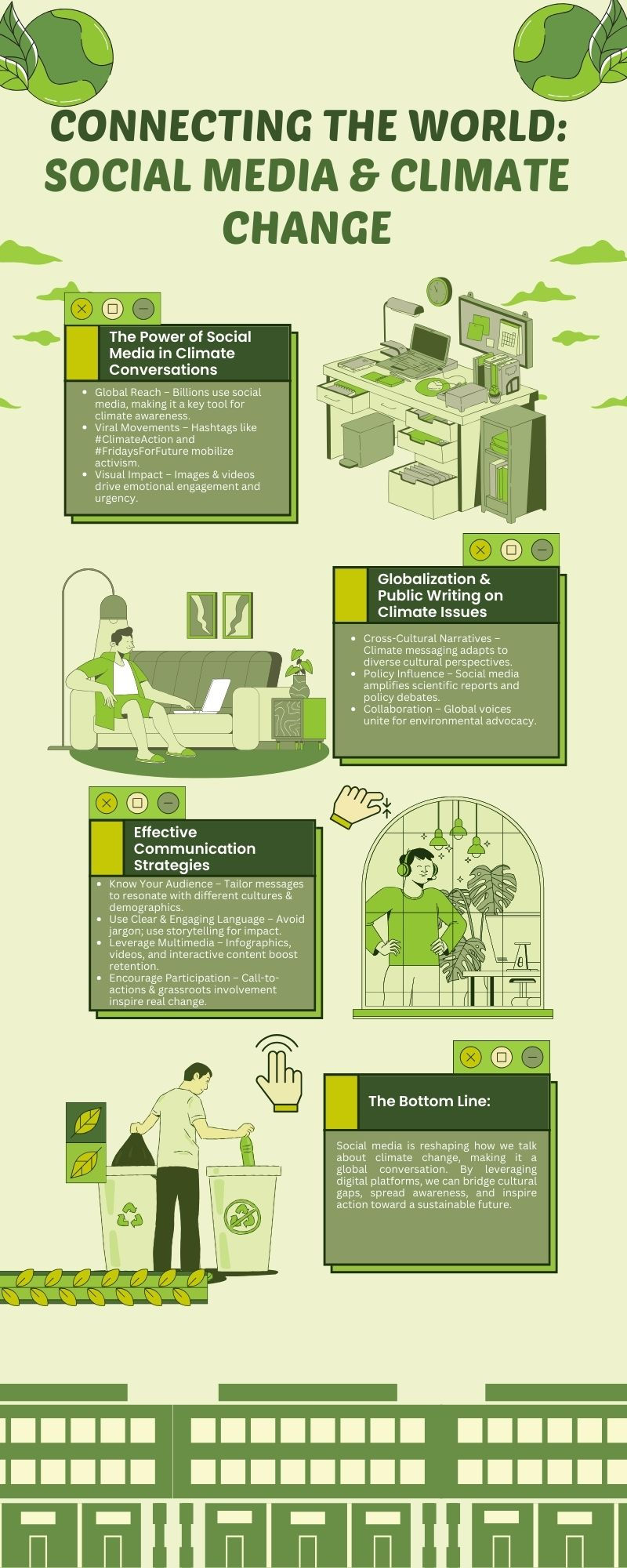
Hello Lillian, this will be a shorter response to your blog post. I wanted to start by addressing the infographic at the start of the post. I thought that this was a very unique and interesting way to both gain your readers attention and teach them a couple things. I really enjoyed the genre and subject matter sections. However, I wish you went a little deeper into the portion “creating community expectations”. I think that this could really add to the overall argument you are making within this blog post. Overall, I really enjoyed reading through your post and look forward to seeing more in the future.
Lillian:
Hey Lillian!
I really loved your setup of this blog post. I thought your infographic at the beginning was easy to follow and did a good job of sort of speaking for you in regards to introducing your blog topic to your audience.
What I Loved:
I loved how you stress the importance of not delivering “superficial and misleading communication”. When I read the term superficial, I read it as “white washed” or non inclusive. I think this absolutely applies when dealing with climate change because as we know, marginalized communities are the most impacted, and are always the communities least talked about.
I really enjoyed how you set up your different subsections with the bullet points and the…